STARS INTEGRATIVE CARE WITH TMS
starsmedpsych.com | (470) 253–1350
TMS SERIES • PART 3
How TMS Therapy Actually Works: The Science, the Technology, and What Happens in Your Brain
What Is TMS Therapy? — Part 3
Dr. Chriss Mulumba, MD | Board-Certified Psychiatrist | STARS Integrative Care with TMS | Suwanee, GA
In Part 1 of this series, I introduced TMS therapy — what it is, who it’s designed for, and what to expect during a course of treatment. In Part 2, we looked at how TMS works to target the brain circuits involved in depression. If you haven’t read those posts yet, I’d encourage you to start there.
In this post, I want to go deeper. If you’re someone who wants to truly understand how a treatment works before committing to it — this one is for you.
We’ll cover the neuroscience behind TMS, how the magnetic technology actually generates brain activity, and the different types of TMS now available — including standard TMS, deep TMS, and accelerated protocols. By the end, you’ll have a clear, science-informed picture of what makes TMS work and how we approach it here at STARS.
Part 1: The Neuroscience of Depression — Why the Brain Needs More Than Chemistry
To understand how TMS works, it helps to understand something about what depression actually does in the brain.
Depression is not simply a chemical imbalance — though that’s the explanation most people have heard. The reality is more complex. Depression involves changes in the structure, activity, and connectivity of specific brain circuits, particularly those involved in mood regulation, decision-making, attention, and emotional processing.
One of the most consistently documented findings in depression research is reduced activity in a region of the brain called the dorsolateral prefrontal cortex — or DLPFC. This area, located at the front and sides of the brain, plays a central role in executive function, emotional regulation, and cognitive flexibility. In people experiencing depression, the DLPFC tends to be underactive. Its communication with deeper emotional processing regions — including the amygdala and limbic system — is disrupted.
Antidepressants address this by altering neurotransmitter levels — the chemical messengers that neurons use to communicate. This can be effective for many patients. But for others, the circuit-level dysfunction goes beyond what chemistry alone can correct. That’s where TMS comes in.
TMS doesn’t adjust chemistry. It adjusts activity. By delivering targeted magnetic pulses to the DLPFC, TMS directly stimulates underactive neural circuits — essentially helping the brain rebuild healthier patterns of activity over the course of treatment.
Part 2: How Magnetic Pulses Stimulate Brain Cells
Here’s the core mechanism — explained as simply as I can make it without losing the accuracy.
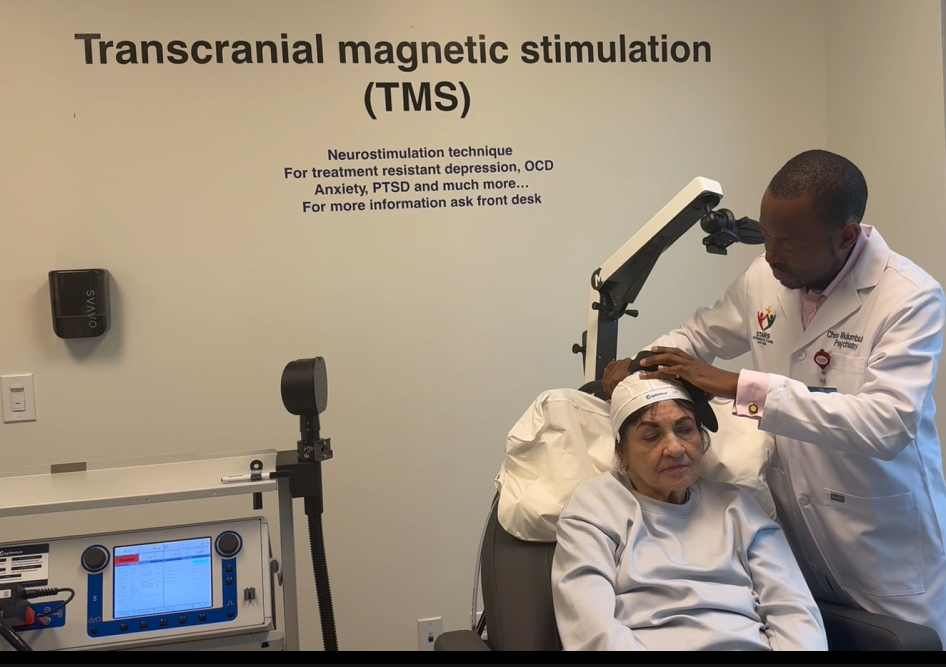
The TMS device contains a coil — an electromagnetic device that generates a rapidly changing magnetic field when electrical current passes through it. This magnetic field passes through the skull and scalp without any electrical sensation at the skin level.
Once the magnetic field reaches the brain tissue beneath, it induces a small electrical current in the neurons there. That induced current is enough to depolarize the neurons — meaning it causes them to fire. When neurons in the DLPFC fire repeatedly in a controlled pattern, several things happen over time:
- Synaptic connections between neurons are strengthened — a process related to neuroplasticity
- Communication between the DLPFC and deeper emotional processing regions begins to normalize
- The overall pattern of activity in the mood-regulation network gradually shifts toward healthier baseline function
This is why TMS is not an immediate fix. Like physical therapy for a muscle, the brain needs repeated stimulation over time to rebuild. Most patients complete 36 sessions over six to nine weeks — and the changes accumulate progressively.
The magnetic pulses used in TMS are similar in strength to those produced by an MRI machine — powerful enough to induce neural activity, but not strong enough to damage tissue. The treatment is non-invasive, requires no anesthesia, and does not affect memory or cognition.
Part 3: Types of TMS — Standard, Deep TMS, and Accelerated Protocols
TMS is not a single, uniform treatment. Over the past decade, the technology and protocols have evolved substantially. Here’s a breakdown of the primary types of TMS that are currently used clinically.
Standard TMS (Figure-8 Coil)
This is the original and most widely used form of TMS. It uses a figure-8 shaped coil — named for its shape — that focuses the magnetic field on a relatively precise area of the cortex, typically the left DLPFC.
Standard TMS delivers what’s called repetitive TMS, or rTMS — pulses delivered in rhythmic bursts designed to either increase or decrease activity in the targeted region. For depression, high-frequency stimulation (typically 10 Hz) of the left DLPFC is the most established protocol.
This is the form of TMS cleared by the FDA in 2008, and it remains the most studied and clinically validated approach. At STARS, we use the MagVenture TMS system, which uses a figure-8 coil and follows the established stimulation parameters that have been validated in large clinical trials.
Deep TMS (H-Coil)
Deep TMS uses a different coil design — called the H-coil — that generates a broader and deeper magnetic field, reaching brain structures up to approximately 6 centimeters below the scalp, compared to roughly 2–3 centimeters with standard coils.
Deep TMS received FDA clearance in 2013 for major depressive disorder. More recently, it has also been cleared for obsessive-compulsive disorder (2018) and smoking cessation (2020), reflecting its ability to reach deeper brain structures involved in those conditions.
The tradeoff is specificity: deeper reach comes with a broader field and less precise targeting. For most patients with depression, standard TMS remains the first-line approach. Deep TMS may be particularly relevant for patients with co-occurring conditions like OCD.
Accelerated TMS (Including iTBS)
Traditional TMS protocols involve one session per day, five days per week, for six to nine weeks — a significant time commitment. Accelerated TMS protocols were developed to compress this timeline.
The most notable accelerated approach is called intermittent theta-burst stimulation, or iTBS. Theta-burst stimulation delivers pulses in a pattern that mimics naturally occurring brain rhythms — and it can produce comparable effects to standard rTMS in dramatically shorter sessions.
The FDA cleared iTBS for depression in 2018. A single iTBS session can be completed in approximately 3 minutes, compared to 20–30 minutes for standard TMS.
Accelerated TMS protocols — sometimes called SAINT (Stanford Accelerated Intelligent Neuromodulation Therapy) in research settings — have shown promising results in clinical trials, with some patients achieving remission within days rather than weeks. These protocols involve multiple sessions per day over a condensed period.
Accelerated protocols are an active area of research and clinical development. Availability and insurance coverage vary. At STARS, we individualize every treatment plan based on clinical evidence, patient history, and insurance authorization.
TMS Protocols at a Glance
| Feature | Standard rTMS | Deep TMS (H-Coil) | iTBS (Accelerated) |
| FDA Cleared (Depression) | 2008 | 2013 | 2018 |
| Coil Type | Figure-8 | H-Coil | Figure-8 |
| Depth of Stimulation | ~2–3 cm | ~6 cm | ~2–3 cm |
| Session Length | 20–30 min | ~20 min | ~3 min |
| Sessions per Day | 1 | 1 | 1–5+ |
| Also FDA Cleared For | Major Depressive Disorder | MDD, OCD, Smoking Cessation | Major Depressive Disorder |
Note: This table is a simplified clinical overview. Specific protocols, coil configurations, and eligibility vary. Consult your psychiatrist for individualized guidance.
Part 4: Why the Technology Matters for Your Outcome
One question patients sometimes ask me is: does it matter which TMS system is used?
The honest answer is: protocol and precision matter more than brand alone. What matters most is that the system being used is FDA-cleared, that the treating physician has properly mapped the stimulation target for your anatomy, and that the protocol is being delivered consistently over the full treatment course.
At STARS, we use MagVenture — a well-studied, FDA-cleared TMS platform with a strong clinical evidence base. Before your first session, the coil placement is carefully calibrated to your specific anatomy to ensure accurate targeting of the left DLPFC.
This precision is part of why I take the initial consultation seriously. TMS isn’t something we start without a thorough evaluation. Your history, your biology, and your goals all factor into how we approach your care.
What This Means for You
If you’ve made it to the end of this post, you now understand more about TMS than most people — including many who have already started treatment.
Here’s what I’d want you to take away:
- TMS works by stimulating underactive brain circuits — not by altering brain chemistry through drugs
- The technology uses magnetic fields similar in strength to an MRI, applied externally and non-invasively
- Different types of TMS exist — standard, deep, and accelerated — each with distinct characteristics and clinical use cases
- Results build over a full treatment course, typically six to nine weeks
- The right protocol depends on your individual history, diagnosis, and insurance coverage
Ready to Learn More? Let’s Talk.
STARS Integrative Care with TMS
4330 Johns Creek Pkwy, Suite 400, Suwanee, GA 30024
(470) 253–1350 | starsmedpsych.com
Accepting new patients • Aetna • BCBS • Cigna • United Healthcare • Humana
Dr. Chriss Mulumba is a board-certified psychiatrist and co-founder of STARS Integrative Care with TMS in Suwanee, Georgia. He specializes in TMS therapy, Spravato (esketamine) treatment, and comprehensive psychiatric care for adults.
