
STARS Integrative Care with TMS
A Safe Place That Harbors Hope & Healing
4330 Johns Creek Pkwy, Suite 400, Suwanee, GA 30024
(470) 253–1350 | starsmedpsych.com
What Is TMS Therapy? Part I
A Guide for People Who Have Tried Antidepressants and Still Struggle
Dr. Chriss Mulumba, MD | Board-Certified Psychiatrist
What Is TMS Therapy? A Guide for People Who Have Tried Antidepressants and Still Struggle
By Dr. Chriss Mulumba, MD | Board-Certified Psychiatrist | STARS Integrative Care with TMS | Suwanee, GA
If you’ve been living with depression and have tried antidepressant medications that just didn’t work — or stopped working — I want you to know something important:
You are not out of options. And you are not alone.
Millions of people try antidepressants and don’t get the relief they hoped for. That experience is more common than most people realize — and it can be exhausting, discouraging, and isolating. As a psychiatrist, it’s one of the most difficult things I see patients go through.
That’s part of why TMS therapy is one of the most meaningful treatments I offer at STARS Integrative Care. It’s a different approach entirely — and for many patients, it’s the one that finally works.
In this post, I want to walk you through exactly what TMS is, how it works, and whether it might be right for you — in plain language, no jargon required.
First: Why Antidepressants Don’t Always Work
Antidepressants are often the first-line treatment for depression, and they help a lot of people. But studies consistently show that about one-third of people with depression do not respond adequately to antidepressant medications, even after trying multiple options.
This is sometimes called treatment-resistant depression — though I prefer to think of it simply as “my brain needs a different approach.”
Medications work primarily through brain chemistry — adjusting levels of serotonin, dopamine, and norepinephrine. TMS works differently. Instead of chemistry, it uses carefully targeted magnetic pulses to directly stimulate the areas of the brain involved in mood regulation.
Think of it this way: if medications are like adjusting the volume on a stereo receiver, TMS is like fine-tuning the speaker itself.
So… What Exactly Is TMS?
TMS stands for Transcranial Magnetic Stimulation. “Trans-cranial” simply means “through the skull.” The treatment uses gentle magnetic pulses — similar in strength to an MRI — to stimulate nerve cells in specific regions of your brain.
The area targeted for depression is called the dorsolateral prefrontal cortex — a part of the brain that tends to be underactive in people experiencing depression. By stimulating that region, TMS helps “wake it up” and restore healthier activity patterns over time.
The FDA cleared TMS for the treatment of major depressive disorder in 2008. Since then, it has been used in hundreds of thousands of patients across the country. At STARS, we use MagVenture TMS — one of the most studied and widely used TMS systems available.
TMS in Plain TermsFDA-cleared: Yes — approved for major depressive disorder since 2008 Non-invasive: No surgery, no sedation, no needles Medication-free: Works without changing your brain chemistry through drugs Outpatient: You come in, sit in a chair, and go home No memory effects: Unlike ECT, TMS does not affect memory or cognition |
What Does a TMS Session Actually Feel Like?
This is one of the first things patients ask me — and I’m glad they do, because the reality is much simpler than most people expect.
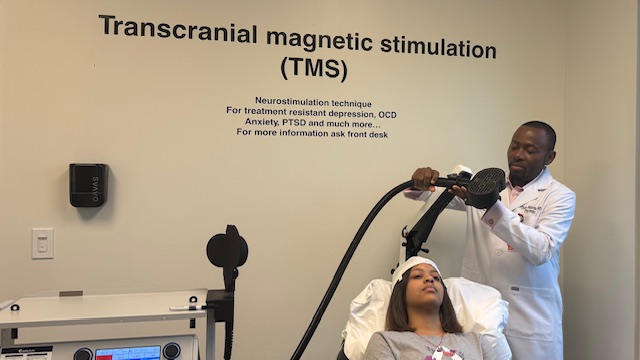
You come into the office, sit in a comfortable chair — fully awake and alert — and a trained technician places a small magnetic coil gently against the side of your head. The device delivers a series of magnetic pulses to the targeted brain region.
Most patients describe the sensation as a light tapping or clicking on their scalp. Some people feel mild discomfort in the first few sessions as they adjust, but the vast majority of patients tolerate TMS very well.
Each session takes about 20–30 minutes. You’re awake the entire time. You can listen to music, sit quietly, or just relax. When it’s done, you walk out the door and go about your day — no recovery time needed.
A standard course of TMS is typically 36 sessions over about six to nine weeks, with sessions scheduled five days a week. We work with your schedule to make this as manageable as possible.
Does TMS Actually Work?
Yes — and the research is substantial.
Clinical trials have consistently shown that TMS produces meaningful improvement in depression symptoms for a significant percentage of patients who have not responded to antidepressants. Many patients experience a significant reduction in symptoms, and a meaningful number achieve full remission.
Results don’t happen overnight. Most patients begin to notice changes in weeks 3–5 of treatment. Some feel it sooner; for others it takes the full course. I always tell my patients: trust the process, and keep coming in.
The effects of TMS can last for a year or longer. Some patients choose to do a brief maintenance course to preserve their results. We individualize every treatment plan based on your history and response.
TMS vs. Antidepressants: A Quick Comparison
| Antidepressants
Work through brain chemistry Daily oral medication Systemic side effects possible (weight, sleep, libido) May take 4–8 weeks to assess effect Ongoing daily use often needed |
TMS Therapy
Works through targeted brain stimulation In-office sessions, no daily pill Localized — minimal systemic side effects Results often noticed in weeks 3–5 Many maintain results without ongoing medication |
Who Is TMS Right For?
TMS may be a good fit if any of the following describes you:
- You have been diagnosed with major depressive disorder
- You have tried one or more antidepressant medications without adequate relief
- You stopped an antidepressant due to side effects you couldn’t tolerate
- You are looking for a medication-free treatment option
- You are currently taking an antidepressant but want to explore additional support
TMS is not the right fit for everyone. Patients with certain metal implants in or near the head (such as cochlear implants or certain types of aneurysm clips) are typically not candidates. During your initial consultation, I will conduct a full evaluation to determine whether TMS is appropriate for your specific situation.
Will My Insurance Cover TMS?
| Insurance Coverage at STARS
We accept: Aetna, Blue Cross Blue Shield, Cigna, United Healthcare, Humana Most major private insurance plans cover TMS for qualifying patients with a diagnosis of major depressive disorder who have not responded to antidepressants. Our team verifies your benefits before your first appointment — no surprises, no guesswork. Not sure if you qualify? Call us: (470) 253–1350 |
Insurance coverage for TMS has expanded significantly in recent years. Most major private insurance carriers now cover TMS for patients who meet clinical criteria — typically, a diagnosis of major depressive disorder and documentation that at least one antidepressant has not worked.
At STARS, we handle the insurance verification process for you before your first session begins. We want you focused on your care — not paperwork.
What to Expect at STARS
Here’s how the TMS process works at our practice:
Step 1: Initial Consultation
You’ll meet with me for a comprehensive psychiatric evaluation. We’ll review your history, your previous treatments, and your goals — and determine whether TMS is the right next step.
Step 2: Insurance Verification
Our team verifies your benefits and handles prior authorization with your insurance carrier. We’ll walk you through your coverage clearly before you commit to anything.
Step 3: Treatment
You’ll come in for your sessions — typically five days a week for six to nine weeks. Our team is here with you every step of the way, monitoring your progress and adjusting as needed.
Step 4: Ongoing Support
After your treatment course, we continue to monitor how you’re doing and support your long-term mental health. STARS is an integrated practice — your psychiatric care, TMS, and primary care can all happen under one roof.
You Deserve More Than “Just Try Another Pill”
If you’ve been going through the cycle of trying medications, adjusting doses, and still not feeling like yourself — I hear you. That experience is exhausting, and it doesn’t mean nothing will ever work.
TMS is not a miracle cure, but for many patients, it’s the first treatment that has actually made a meaningful, lasting difference. I’ve seen it change lives — and I’d love to talk with you about whether it could change yours.
At STARS Integrative Care with TMS, we don’t offer cookie-cutter care. We offer an evaluation, a real conversation, and a treatment plan built around you.
Ready to Learn More? Let’s Talk.STARS Integrative Care with TMS 4330 Johns Creek Pkwy, Suite 400, Suwanee, GA 30024 (470) 253–1350 | starsmedpsych.com Accepting new patients | Aetna | BCBS | Cigna | United Healthcare | Humana Request an Appointment: starsmedpsych.com/request-an-appointment/ |
Dr. Chriss Mulumba is a board-certified psychiatrist and co-founder of STARS Integrative Care with TMS in Suwanee, Georgia. He specializes in TMS therapy, Spravato (esketamine) treatment, and comprehensive psychiatric care for adults
